It's Kimika
itsKimika
Why the 50/30/20 Rule No Longer Works — And What to Use Instead
By @itsKimika
My mission is to help you become financially harder to break. I give my complete Rule of 3: Fixed / Flexible / Freedom Framework™ with the new split percentages — in a free PDF. No email. No gatekeeping · Download the free PDF here.
The 50/30/20 rule doesn't work for most people — and here's why.
Here's what the 50/30/20 budgeting rule doesn't tell you. It doesn't tell you what to do when 50% of your income barely covers rent and minimum debt payments. It doesn't tell you whether to pay off debt or build an emergency fund first. It doesn't tell you what "savings" even means when you're $40,000 in debt versus when you're debt free. It collapses everything — debt payoff, emergency fund, investing, sinking funds — into one tidy 20% bucket and calls it done.
Simple and clean. But not enough.
The Problem with Universal Splits
For most of the 20th century, personal finance guidance came in the form of simple rules handed down by lenders, economists, and self-help authors. Save 10%. Don't spend more than 30% on housing. Keep debt under 36% of income.
The 50/30/20 rule was the most meaningful update to all of it — the first framework to work from after-tax income, which was a genuine improvement.
But it carried the same fundamental flaw as everything before it: one split for everyone.
The woman rebuilding from $40,000 in debt on a $55,000 salary and the woman who is debt free and earning $120,000 should not be splitting their paychecks the same way. Giving them the same percentage targets isn't guidance. It's a guess dressed up as a rule.
Your split isn't determined by what worked for a previous generation, or what a financial author decided was tidy enough to fit on a page. It's determined by two things: the stage of your financial life you're currently in, and what you ultimately want your money to build toward.
Those two things will never be identical for any two people. Which means the right framework can't hand you a single number. It has to hand you a way of thinking.
The Law Your Money Already Obeys
Here's something nobody in personal finance talks about.
Your money is already governed by a law — whether you see it or not. This is the Law of Financial Physics. This concept is mostly used in terms of investing but I'm using it for Personal Finance. Every dollar that leaves you is a purchase. Always. Without exception. You are either buying something consumer — goods, services, experiences, the home you live in, the dinner you enjoyed — or you are buying something investment: an asset designed to generate more money than it cost.
Those are the only two categories. Everything money does on the way out fits inside one of them.
Whatever you buy lands in one of three places: your Fixed Expenses, your Flexible Expenses, or your Freedom Moves. Every single purchase, every single time, activates one of those three buckets. There is no fourth option. There is no purchase that escapes the equation.
This is my Rule of 3.
The moment you can see which part of your foundation absorbs a cost, you stop making decisions by accident and start making them by design. That is what it means to be financially harder to break. Not spending less. Not living like a monk. Knowing more.
The Framework Built on That Law: Fixed / Flexible / Freedom
So I humbly offer into this conversation my Rule of 3: Fixed / Flexible / Freedom Framework™ — the first framework I'm aware of that accounts for where you actually are and builds wealth building into every stage of the journey.
I came from a single income household, raised in a low-income neighborhood in the Bronx, made every money mistake in the book, hit rock bottom at almost 30 with $150,000 in debt and $25 to my name — and still built over a half-million-dollar net worth in my 30s on a regular salary, most years making under $100K. The 50/30/20 rule was not the framework that got me there.
This is.
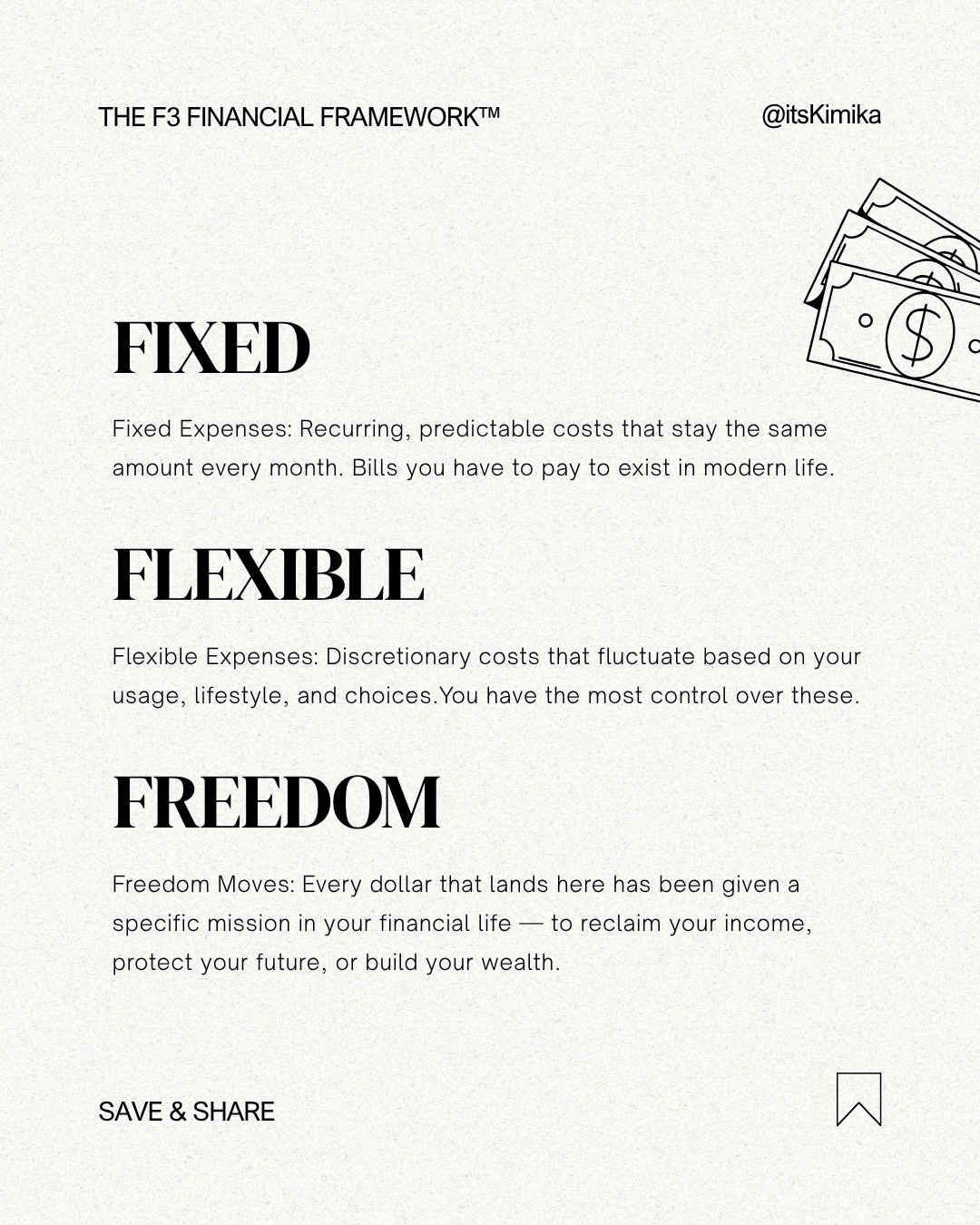
Every dollar you earn falls into one of three buckets:
Fixed Expenses — recurring, predictable costs that stay the same every month. Your floor. The goal is to keep this intentionally lean so the other two buckets have room to breathe.
Flexible Expenses — costs that fluctuate based on your usage, lifestyle, and choices. Groceries. Dining out. Entertainment. This is where most of your day-to-day decisions live — and where most of the compression opportunity is when you need to grow your third bucket.
Freedom Moves — not an expense category. A deployment category. Every dollar here has a specific mission: reclaim your income, protect your future, or build your wealth. Extra debt payments. Savings. Investing. The backbone of every income stream beyond your paycheck.
This is the bucket every framework before this one treated as optional. The F3 Framework™ treats Freedom Moves as a co-equal claim on your income from the start. Not what's left. What's allocated — deliberately, from dollar one.
One principle runs through all of it: give every dollar a job. Every dollar you earn gets assigned a destination before the month starts. If a dollar doesn't have a job, it will find one on its own. And you probably won't like what it picks.
Download the Guide
If this is clicking — if you're already thinking about which stage you're in or what your Freedom percentage actually looks like right now — the full framework is waiting for you. Download the complete Fixed / Flexible / Freedom Framework™
The Four Stages of a Financial Journey
Here's where the framework does something no framework before it has done: it adjusts to you.
I created four stages to help you find where you actually are — because the smart move at Mobilize is completely different from the smart move at Maximize. Each stage has its own split, its own priorities, and its own version of what Freedom Moves should be doing with your money.
⚡ Mobilize — Your income barely covers necessities. Debt payments are eating your paycheck. A financial emergency feels like a matter of when, not if. Staying still is costing you.
🏗 Stabilize — Your income covers your bills and you have a little breathing room. But you're still paycheck to paycheck and not actually building anything. You're not drowning — but you're not swimming either.
🧭 Optimize — Your bills are paid. You could save if you chose to. But somehow you're still not getting ahead. The problem isn't your income. It's the leaks.
🔝 Maximize — You have a real surplus every month. You're investing. The question is no longer how to survive — it's how to make every dollar work harder.
The exact split percentages for each stage — what your Fixed, Flexible, and Freedom should look like at Mobilize versus Maximize — are in the full PDF I'm giving you for free.
Knowledge to Build Wealth
Most people would put something like this behind an opt-in form. I thought about it.
But I built this framework because I needed it and it didn't exist. I built it from the Bronx, from rock bottom, from $150,000 in debt — and I want it to reach the woman who is in that exact place right now and doesn't know there's a system designed specifically for where she is.
So the PDF is free. Instantly. No email required.
If it helps you — share it. Send it to the friend who keeps saying she needs to get her finances together. That's the only ask.

The Money Manual
A free curated collection with the financial foundations nobody taught you.
Wealth on Lock™
Wealth on Lock turns the phone lock screen you're already looking at 80 times a day into a Wealth Operating System — one daily money action that gets your money together in 30 days.

Download the free PDF here
This post scratches the surface. If you want the complete Fixed / Flexible / Freedom Framework™ — the full stage breakdowns, the splits, the system — it's yours. No email. No catch.