It's Kimika
itsKimika
The Books That Shaped My Journey From $150,000 in Debt to a $500,000+ Net Worth
By @itsKimika
My mission is to help you become financially harder to break. Check out this article next Why the 50/30/20 Rule No Longer Works — And What to Use Instead it's about a new way of organizing your money.
If you've ever looked around and felt like everyone else got a secret handbook for money that somehow skipped your inbox, I used to feel that way too.
Because despite what social media would have you believe, most people don't wake up one day knowing how to pay off debt, invest confidently, avoid lifestyle inflation, or build wealth on a regular salary.
And before we jump in, I want to acknowledge something.
I have tremendous respect for every author on the list I'm about share. Many of their ideas shaped how I think about money today.
Some of these books are written by authors who learned about money early, grew up in financially stable households, had mentors.
Some of these books are written by authors who never carried six figures of debt and never had to climb out of a deep financial hole.
My reality was different from most if not all of these authors.
My mom was an inner-city high school teacher in the Bronx. We were lower middle class at best in a low-income neighborhood. My mom was a great saver but there was still financial instability on a single income.
Suffice it to say I didn't learn about money from a parent.
I made a lot of dumb money mistakes. Ended up broke and had to climb out of rock bottom.
At almost 30, I had $25 to my name, over $150,000 of debt, and moved back home because I had run out of options.
It was a pivatol moment when I became debt free and my net worth crossed the half-million-dollar mark.
No inheritance.
No wealthy parents.
No six-figure side hustle.
Just a regular paycheck, a lot of mistakes, and a lot of learning.
I also learned something important about the different books I read along the way:
Most financial advice isn't wrong. It's written for a different starting point.
The books that helped me stop drowning were completely different from the books that helped me build wealth.
Looking back, I realized they naturally fit into the four financial journey stages (Mobilizing →Stabilizing →Optimizing →Maximizing) that lives within the Rule of 3: Fixed / Flexible / Freedom Framework™.
The woman rebuilding from debt (Mobilizing) and the woman investing 35% of her income (Maximizing) shouldn't be following the same playbook.
Yet that's exactly what most traditional financial advice assumes.
That's also why I believe the 50/30/20 Rule no longer works for many people today.
(If you're unfamiliar with my Rule of 3: Fixed / Flexible / Freedom Framework™, check out: Why the 50/30/20 Rule No Longer Works — And What to Use Instead.)
Before we dive into the list: Some of the links below are affiliate links. If you buy through them, Amazon may send me enough money to fund approximately half a latte at Starbucks ☕ 😉 Seriously though, I only recommend books that genuinely shaped how I think about money and wealth building.
Now let's talk about the books.
Stages: ⚡ Mobilize and 🏗️ Stabilize
"I need to stop the financial bleeding."
This stage is where survival mode lives.
Debt is heavy.
The emergency fund is tiny (or nonexistent).
Every unexpected expense feels personal.
The goal here isn't maximizing returns.
The goal is getting your financial life moving in the right direction.
The Total Money Makeover — Dave Ramsey (link)
One-line lesson: You can't build wealth while your debt is setting your paycheck on fire.
Love him or hate him, Dave Ramsey is exceptionally good at helping people take action.
His advice isn't always mathematically perfect.
But when you're drowning, behavior matters more than optimization.
My mom is the one who introduced me to Dave Ramsey. She gave me this book as a gift when I was at my lowest financial point ($150,000 in the hole). At that stage of my life the way he packaged his method resonated. There is a lot that I disagree with now but fundamentally Dave Ramsey is good at shocking people out of debt.
Get a Financial Life — Beth Kobliner (link)
One-line lesson: Adulting isn't a personality trait. It's a collection of financial systems.
This is one of those books that fills in all the gaps nobody taught us in school.
Credit.
Retirement accounts.
Insurance.
Taxes.
All the stuff that suddenly becomes your problem once you start earning a paycheck.
The Spender's Guide to Debt-Free Living — Anna Newell Jones (link)
One-line lesson: Your spending habits often have emotional roots, not mathematical ones.
The author dives into the psychology behind spending and why so many smart people continue making decisions that keep them stuck.
Because money problems are rarely just money problems.
They're behavior problems.
The Richest Man in Babylon — George Samuel Clason (link)
One-line lesson: Pay yourself first.
Simple.
Timeless.
Still relevant almost a century later.
A note for women in Mobilize or Stabilize
One thing I wish existed when I was rebuilding my finances was a way to stay focused every day.
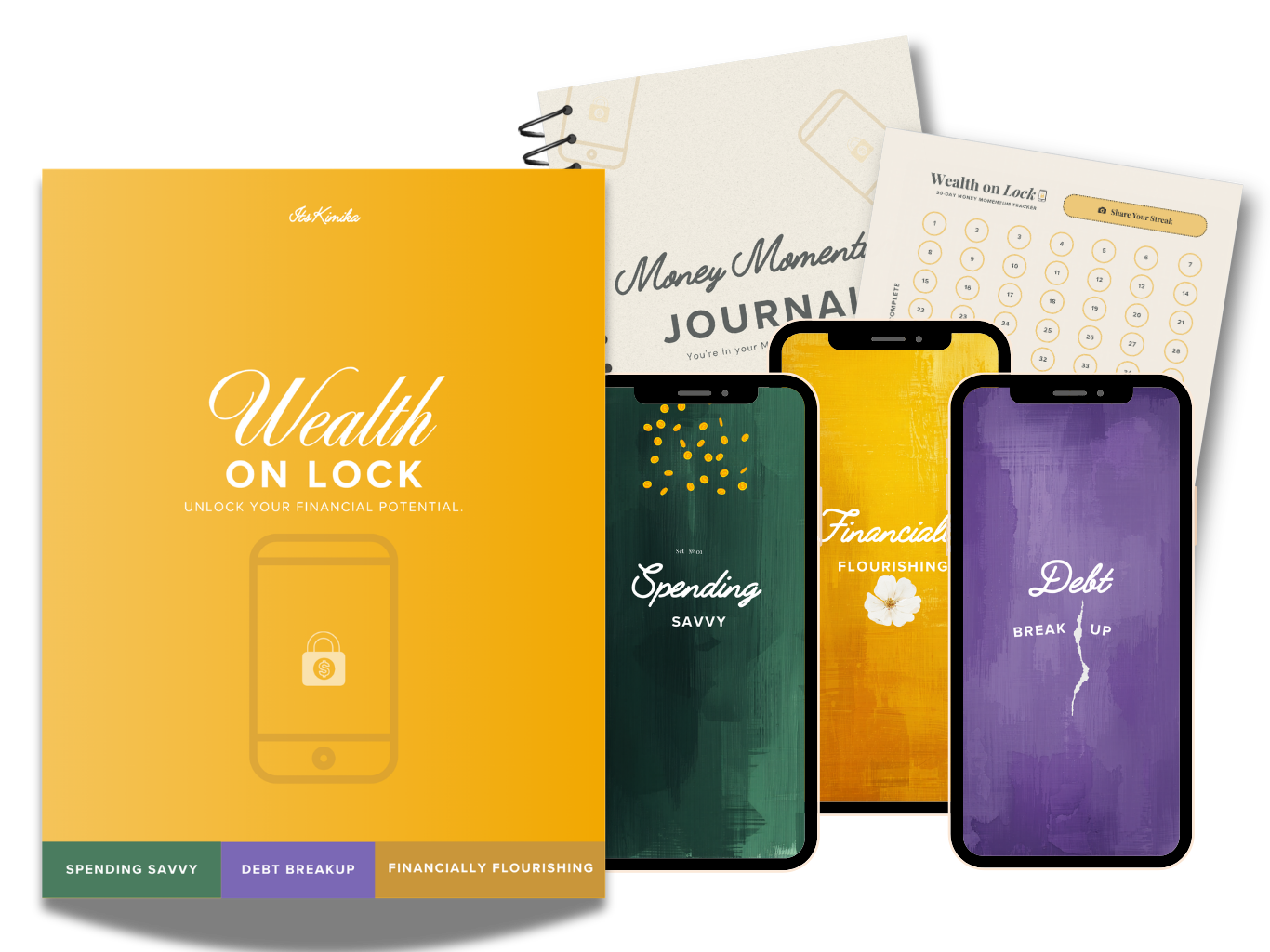
That's part of what inspired Wealth on Lock™ — turning the screen you're already looking at 80 times a day into a daily money habit.
Because consistency beats motivation every time.
Stage: 🔧 Optimize
"Why am I making decent money and still not getting ahead?"
This stage is sneaky.
Nothing is on fire.
Bills are paid.
Income is okay.
But wealth isn't growing as quickly as it should.
This is where optimization becomes more important than income.
The Psychology of Money — Morgan Housel (link)
One-line lesson: Financial success is driven more by behavior than intelligence.
This book completely changed how I think about wealth.
Money is rarely a spreadsheet problem.
It's usually a behavior problem.
Atomic Habits — James Clear (link)
One-line lesson: You do not rise to your goals. You fall to your systems.
Technically not a money book.
Practically one of the best money books I've ever read.
Wealth is usually the result of repeated actions that nobody sees.
Investing.
Saving.
Avoiding impulse spending.
Making smart decisions consistently.
The Bogleheads' Guide to Investing — Multiple Authors (link)
One-line lesson: Simple investing works surprisingly well.
A Random Walk Down Wall Street — Burton Malkiel (link)
One-line lesson: Most investors are not smarter than the market.
The Intelligent Investor — Benjamin Graham (link)
One-line lesson: The biggest risk in investing is often your own behavior.
Fair warning:
This book is dense.
Like "read three pages and reward yourself with a snack" dense.
But it's a classic for a reason.
When knowledge isn't the problem anymore
Eventually I realized I knew what I should do with my money.
The challenge became actually deploying every dollar intentionally.
That realization later became the foundation for The Money Mapping Method™ and eventually the F3 Framework itself.
Download the Guide
If this is clicking — if you're already thinking about which stage you're in or what your Freedom percentage actually looks like right now — the full framework is waiting for you. Download the complete Fixed / Flexible / Freedom Framework™
Stage: ⬆️ Maximize
"How do I make every dollar work harder?"
This stage is where survival is no longer the primary concern.
You're investing.
You have a surplus.
Now the question becomes leverage.
Rich Dad Poor Dad — Robert Kiyosaki (link)
One-line lesson: Assets put money into your pocket. Liabilities take money out.
Another personality that you might love, hate or feel ambivalent towards. Either way look past messenger and see what lessons your can glean in the message. It made me believe that buying assets wasn't just something rich people did, which ultimately led me to buying a rental property.
Cashflow Quadrant — Robert Kiyosaki (link)
One-line lesson: How you earn money matters just as much as how much you earn.
The Book on Rental Property Investing — Brandon Turner (link)
One-line lesson: Real estate is a business, not a lottery ticket.
The Book on Advanced Tax Strategies — Amanda Han (link)
One-line lesson: Making money is important. Keeping more of it matters too.
Shoe Dog — Phil Knight (link)
One-line lesson: Every successful business looks obvious after it succeeds.
You Are a Badass at Making Money — Jen Sincero (link)
One-line lesson: Your earning potential is often limited more by your beliefs than your ability.
We Should All Be Millionaires — Rachel Rodgers (link)
One-line lesson: Women don't need to apologize for wanting wealth.
Too many women are comfortable talking about budgeting and uncomfortable talking about becoming wealthy.
The two conversations should coexist.
Abundance Now — Lisa Nichols (link)
One-line lesson: Scarcity thinking often creates scarcity decisions.
The Secret — Rhonda Byrne (link)
One-line lesson: Vision without action is just expensive daydreaming.
Think and Grow Rich — Napoleon Hill (link)
One-line lesson: Your beliefs influence the opportunities you're willing to pursue.
The Bigger Lesson
Looking back, none of these books made me wealthy.
They gave me the right lesson at the right stage.
That's a huge difference.
The biggest mistake people make is consuming advice that doesn't match the financial reality they're currently living.
The woman trying to pay off $30,000 in credit card debt doesn't need advanced tax strategies.
The woman maxing out her retirement accounts doesn't need beginner debt advice.
Different stage.
Different strategy.
Different priorities.
That's ultimately why I created the Mobilize → Stabilize → Optimize → Maximize stages and the broader Rule of 3: Fixed / Flexible / Freedom Framework™.
Because where you are financially changes what you should focus on next.
The books helped me learn that.
The framework helped me organize it.
And the tools I build today—from Wealth on Lock™ and the Money Mapping Method™ to Paycheck to Prosperity™ and eventually Serin™—are my attempt to make those lessons and my own ideas easier to apply in real life.
Because reading a book is great.
But implementation is what changes your life.
If you're not sure which stage you're currently in, start here:
→ Why the 50/30/20 Rule No Longer Works — And What to Use Instead
It might completely change how you think about your money.
The Money Manual
A free curated collection to help you transform the way you think about money.
Wealth on Lock™
Wealth on Lock turns the phone lock screen you're already looking at 80 times a day into a Wealth Operating System — one daily money action that gets your money together in 30 days.
Download the free PDF here
This post scratches the surface. If you want the complete Fixed / Flexible / Freedom Framework™ — the full stage breakdowns, the splits, the system — it's yours. No email. No catch.